
Booking Jon Stewart
When Rosie O’Donnell bailed on Washington’s buzziest dinner—and Jon Stewart saved the night.

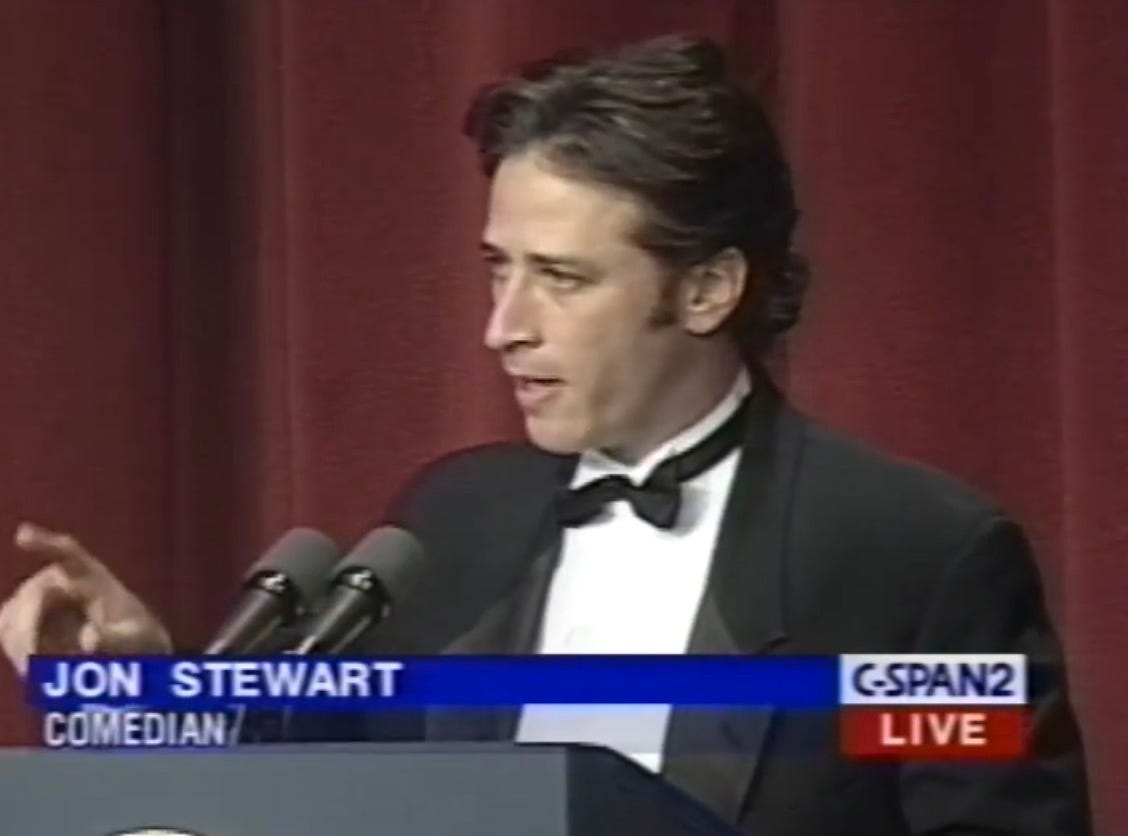
It was the spring of 1997. I was five months widowed, still producing for Larry King Live, now also the owner of a well-known Georgetown bar and restaurant that had belonged to my late husband, and the mother of a five-year-old.
I knew nothing about the restaurant business. I knew everything about talk shows. And there I was, straddling both—while parenting.
Into all this arrived a young, up-and-coming comedian named Jon Stewart.
We became acquainted in the most convoluted experience.
To step back for a moment: somewhere along the way I met Peter Lassally, the legendary executive producer behind The Tonight Show with Johnny Carson and later Late Night and The Late Show with David Letterman. By then he was running Letterman’s production company, Worldwide Pants.
We met in his office above the Ed Sullivan Theater in New York and hit it off in that easy, unmistakable way that sometimes happens between people doing the same kind of work. He was charming, smart, and accessible. Later, when I was in Los Angeles, he and his wife invited me to lunch at their beautiful home overlooking the Pacific.
We talked—enthusiastically—about me possibly working with Worldwide Pants someday. In that imagined future I would be free of Larry King Live, free of the restaurant, and my son and I would be living in New York.
Wishful thinking.
Back in Washington, I was like everyone else in town—looking ahead to the annual White House Correspondents’ Dinner and wondering if I was emotionally up for it. It’s a circus— even in a good year.
That year, it nearly fell apart.
Rosie O’Donnell had been booked far in advance as the headliner. Then, at the eleventh hour—she withdrew. Suddenly the White House Correspondents Association had a full-blown booking crisis, a week or two before the event.
My executive producer at Larry King Live, Wendy Walker, asked if I could help.
“You have the contacts. You know who to call.”
Yes… but Saturday night is sacred in comedy. That’s when comics are working—Vegas, clubs, colleges. You don’t find top-tier talent sitting around waiting.
Still, I made a call to Lassally.
He ran through names. My answer was “yes, yes, yes.” His call back was mostly “no, no, no.” Everyone was booked.
Then he said, “What about Jon Stewart? He’s available.”
I had heard of him. He was under contract to Worldwide Pants, occasionally filling in on The Late Late Show, clearly on the rise, with Lassally and Letterman behind him.
I took it to the WHCA.
The first reaction: “Jon… who?”
My answer, essentially: “He’s good. Not widely known yet, but good. And he’s available. And we’re out of options.”
They said yes.
That week, Jon and I spoke occasionally by phone. He would run ideas by me, and other contacts, testing what might land with a Washington press corps audience—one of the toughest rooms in America. Not only hard to make laugh, but famously inclined to talk right through the entertainment. Even Ray Charles hadn’t been spared.
Toward the end of the week, Jon began reading me his jokes.
I loved them.
They were sharp, topical, smartly aimed at the people who would be sitting in that ballroom. Still, I wondered: am I qualified to judge?
What I wanted most was for Jon to succeed.
Saturday night came.
Julia Whiston, the WHCA executive director, seated me front and center, just below the dais, at a table with Jon’s girlfriend, his mother, and WHCA friends. On my left sat Al Franken, no longer with Saturday Night Live and not yet a senate candidate.
He leaned toward me, nodded at the dais—at Bill Clinton—and indicated, not so subtly, that he had worked on Clinton’s jokes. My heart sank.
In political humor, there are only so many viable targets in a given week. Would Jon’s material overlap with the president’s?
After dinner was cleared, Clinton took the podium and delivered a polished stand-up set. The room roared. Franken beamed.
I had a fleeting urge to bop him on the head.
But my eyes were on Jon.
He quietly shuffled through his cards, pulling some out, adjusting on the fly. We caught each other’s eye. I smiled—with encouragement.
Jon’s set was strong—smart, confident, sharp.
Was it uphill? Of course. Following the president of the United States usually is. And it didn’t help that parts of the room kept talking, drinking, talking, and tuning in, with some laughs.
But he did it. He pushed through. A big stage, short notice, a difficult room—and he delivered. A pro.
The next day, Jon, his mother, and his girlfriend joined me and my son, Spencer, for Sunday brunch at our restaurant.
He was in good spirits—relieved, reflective, focusing mostly on what had worked.
I’m not privy to the inner workings of the WHCA, but I’ve heard that over the years Jon was invited back to headline, or simply to attend, and he demurred.
My sense is he remembered the room.